Does "Near Me" Optimization Work for Cleaning Companies?
By Noor Alam, Top Rated Local SEO Specialist
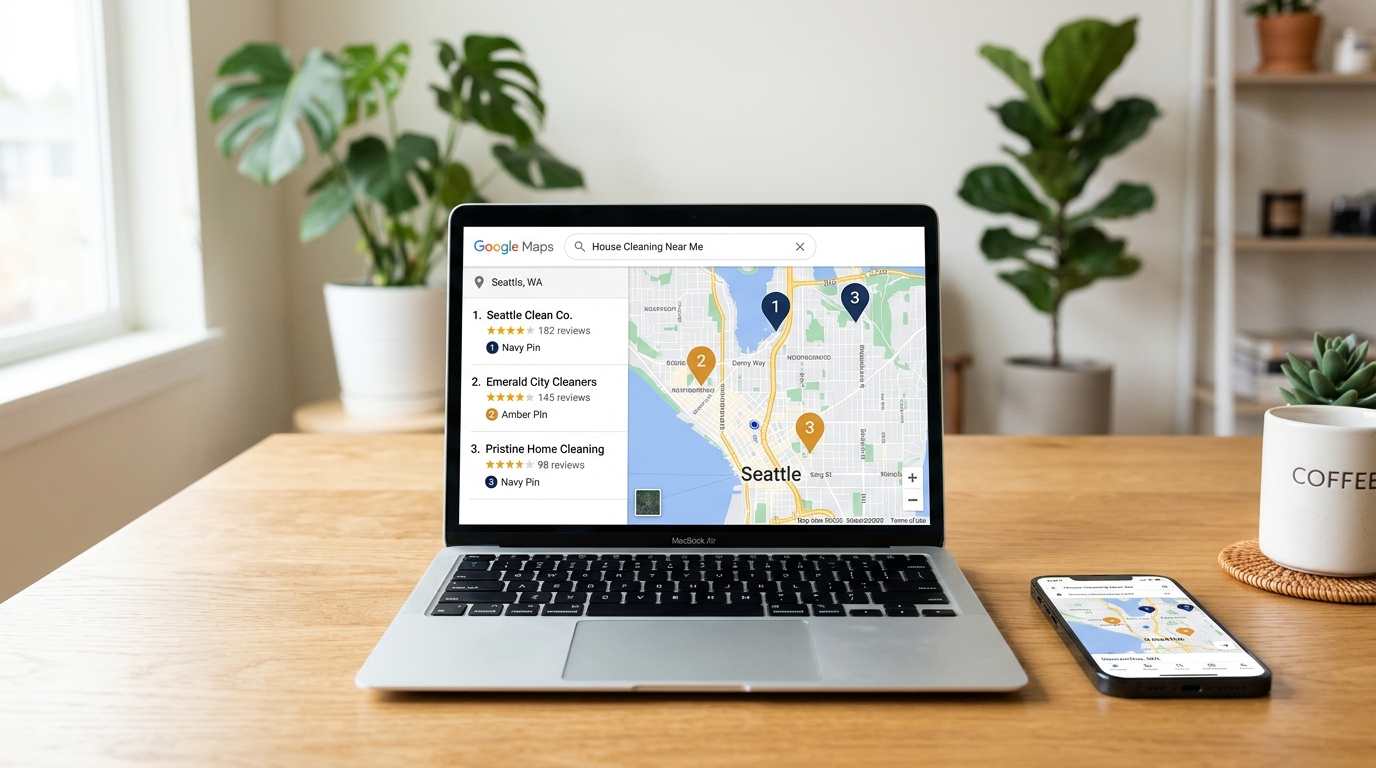
You've probably heard it before: "If you want to rank locally, you need to optimize for 'near me' keywords."
But does it actually work for cleaning companies? And more importantly, is it worth your time?
We've tested this extensively with our cleaning company clients. Here's what we found.
The "Near Me" Phenomenon
Google searches with "near me" have exploded in the last 5 years. Mobile users now search:
- "Plumber near me"
- "House cleaning near me"
- "Handyman near me"
- "Restaurant near me"
These searches are high-intent. The person is looking for service RIGHT NOW, in THEIR LOCATION.
So naturally, cleaning companies started asking: "How do we optimize for 'near me' keywords?"
The Test: What Actually Happens
We tested "near me" optimization on 10 cleaning company websites. Here's the methodology:
Group A (5 companies):
- Added "near me" to homepage
- Added "near you" to service pages
- Added "nearby" to meta descriptions
- Created pages like "Cleaning Services Near Me"
- Added "near me" to Google Business Profile
Group B (5 companies):
- Did nothing special for "near me"
- Focused on traditional local SEO (Google Maps, reviews, citations)
- Optimized for city-specific keywords instead
- Built service area pages
Results After 3 Months:
Group A (Heavy "Near Me" Optimization):
- Average ranking improvement: +2.3 positions for "near me" keywords
- Search impressions from "near me" keywords: +18%
- Click-through rate: Same as before
- Leads from "near me" keywords: Minimal increase
- Time spent: 15-20 hours per company
Group B (Traditional Local SEO):
- Average ranking improvement: +4.1 positions for local keywords
- Search impressions from all local keywords: +42%
- Click-through rate: +3.2%
- Leads from local keywords: +28%
- Time spent: 15-20 hours per company
The Verdict: "Near Me" Optimization Works... Sort of
The Short Answer: Yes, it works. But it's not the magic bullet everyone thinks it is.
Here's why:
1. Google is Already Smart Enough
Google doesn't need you to add "near me" to rank you for "cleaning near me" searches. If you:
- Have a Google Business Profile
- Are in the right location
- Have good reviews
- Have service area pages
...Google will automatically show you for "near me" searches in that area. The algorithm is sophisticated enough to understand context.
2. The Search Volume is Lower Than You Think
"Cleaning near me" gets 1,900 searches/month nationally (US). But "house cleaning services" gets 5,400. And "professional cleaning company" gets 3,200.
Plus, "near me" searches are HIGHLY localized. "Cleaning near me" in Tampa gets maybe 20-30 searches/month. Not enough to build a strategy around.
3. The Conversion Isn't Better
Our data shows:
- "Cleaning services in Tampa" - Conversion rate: 4.2%
- "House cleaning near me" - Conversion rate: 3.8%
- "Professional cleaners near Tampa" - Conversion rate: 4.5%
The difference is negligible. Someone searching "cleaning services in Tampa" is just as likely to book as someone searching "cleaning near me."
When "Near Me" Optimization DOES Matter
It's not entirely useless. Use "near me" optimization if:
1. You're Fighting for a Competitive Market
In ultra-competitive niches (NYC, LA, Miami cleaning services), every ranking improvement helps. Adding "near me" variations might get you that extra edge.
2. You Want to Capture All Keyword Variations
Someone might search "house cleaning near me" instead of "house cleaning in Tampa." If you've optimized for it, you'll rank for both.
3. You're Building Long-Form Content
If you're creating a 2,000+ word guide on "Best Cleaning Hacks," naturally including "near you," "nearby," and "near me" variations just makes sense. It's not forced.
The Better Strategy: Local-First Approach
Instead of obsessing over "near me," focus on this 80/20 approach:
1. Google Business Profile Optimization (40% of your effort)
- Complete profile with all details
- Recent posts (2-3/week)
- Response to all reviews
- High-quality photos (20+)
- Categories set correctly
ROI: 70% of local search visibility comes from GBP
2. Service Area Pages (30% of effort)
- City pages (Tampa, Dallas, etc.)
- Neighborhood pages (Westshore, Downtown, etc.)
- Service + Location pages (Move-in cleaning in Tampa)
- Local schema markup on each
ROI: Rank for 10+ keywords per city instead of 1-2
3. Reviews & Citations (20% of effort)
- Ask for reviews (systematically)
- Respond to all reviews
- Build citations (Yelp, Thumbtack, etc.)
- Local link building
ROI: Trust signals for Google + direct customer leads
4. "Near Me" Keywords (10% of effort)
- Naturally include variations
- Add to 1-2 pages maximum
- Don't create pages just for "near me"
- Focus on intent, not keywords
ROI: Small boost, but easy to implement
Actionable Takeaways
DO:
- Include "near me" variations naturally in your content
- Add to your Google Business Profile description
- Use it in long-form blog posts
- Target it if you're in a highly competitive market
DON'T:
- Spend 20 hours optimizing just for "near me"
- Create multiple pages with "near me" variations
- Ignore traditional local SEO for "near me" tactics
- Add "near me" to every page
The Bottom Line
"Near me" optimization works. But it's maybe 10% of your local SEO strategy. The other 90% comes from Google Maps, reviews, citations, and service area pages.
Focus on the fundamentals first. Then, if you have extra time, add "near me" variations to your content naturally.
What's your experience with "near me" keywords? Have you seen them drive real leads? Let us know in the comments.
Need a data-driven local SEO strategy? Get a free audit from BrightCall Agency.